
The Executive Insight
When most people hear “real‑time analytics” in Fabric, they think:
“Faster dashboard refreshes, maybe 15‑minute latency instead of hourly.”
That’s not what Real‑Time Intelligence is for.
Fabric’s Real‑Time Intelligence (Eventstream → Eventhouse → KQL → Dashboard → Activator) is built for scenarios where seconds of latency create material business impact:
- Equipment failures you want to catch before they halt production.
- Website outages you want to detect before customers notice.
- Inventory drops you want to replenish before shelves empty.
If your use case is “executives want fresher numbers,” you probably want Mirroring or Streaming Datasets in Power BI.
Real‑Time Intelligence is for when the cost of waiting is measured in dollars per minute.
The Old Real‑Time Problem Fabric Solves
Traditional real‑time analytics was a hard problem. You needed:
- Event Hub or Kafka for ingestion.
- Stream Analytics or Spark for lightweight processing.
- Azure Data Explorer or Synapse for querying.
- Power BI streaming datasets or custom dashboards for visualization.
- Logic Apps or Functions for actions.
Each layer was a different service, different skills, different cost model, different SLA.
Fabric Real‑Time Intelligence collapses that into one workload:
- Eventstream: No‑code ingestion and lightweight transformation.
- Eventhouse: Cloud‑native storage for high‑throughput event data.
- KQL Database: Query at scale with Kusto Query Language.
- Real‑Time Dashboard: Live visualization.
- Data Activator: Trigger actions when conditions hit.
The whole stack lives in Fabric, on your capacity, with OneLake integration for persistence and sharing.
When Real‑Time Actually Matters (and When It Doesn’t)
The first decision is not “Do we use Real‑Time Intelligence?” It’s: “Do we actually need real time?”
Real‑time (seconds):
- Manufacturing/IoT: Equipment telemetry → predictive maintenance → avoid downtime.
- Ecommerce/Retail: Website events → detect outages → reroute traffic.
- Logistics: GPS + sensor data → reroute trucks → avoid delays.
- Finance: Trade streams → fraud detection → freeze accounts.
Near‑real time (minutes): Fabric Mirroring or frequent lakehouse refreshes. Batch (hourly/daily): Traditional lakehouse/warehouse.
The pattern I see: most executive dashboards are near‑real time. Real‑Time Intelligence shines in operational monitoring and automation, where seconds matter to operations, not just executives.
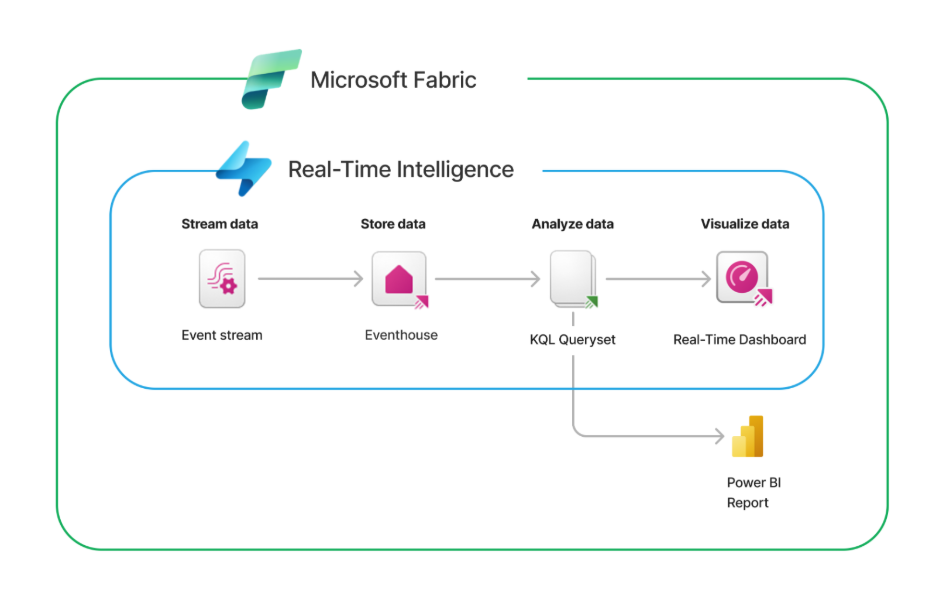
Fabric Real-Time Intelligence pipeline: Eventstream → Eventhouse → KQL → Dashboard → Activator.
Eventhouse: Not Just a KQL Database
Eventhouse is the core storage primitive. It’s purpose‑built for:
- High‑throughput ingestion (petabytes/day).
- Low‑latency querying (sub‑second on fresh data).
- Hot/cold tiering: Hot for real‑time, cold for history.
- Schema‑on‑read for semi‑structured events (JSON, Avro).
KQL (Kusto Query Language) is the querying language—optimized for time‑series, logs, and events. It’s not SQL, but it’s powerful for aggregations, joins, and anomaly detection over streaming data.
Key insight: Eventhouse is not for your star schema. It’s for event streams and time‑series where the schema is wide, the volume is high, and the questions are “what happened recently?”
The Full Stack: From Event to Action
Here’s how the pieces fit together for a complete solution:
- Eventstream: Ingest from Event Hub, Kafka, IoT Hub, SDKs. Lightweight transforms, route to multiple destinations.
- Eventhouse: Store in hot/cold tiers, query with KQL.
- KQL Database: Materialized views, functions for reusable logic.
- Real‑Time Dashboard: Live tiles, auto‑refresh.
- Data Activator: “If X happens, trigger Y” (Teams alert, Logic App, Power Automate).
OneLake integration means your event data can flow downstream to lakehouses/warehouses for deeper analysis.
A Pattern from the Field: “Real‑Time” for the Wrong Thing
Many teams I encounter try Real‑Time Intelligence for:
- Executive KPI dashboards (wrong—use Mirroring or Direct Lake).
- Ad‑hoc streaming experiments (wrong—costly for one‑offs).
Better patterns:
- Manufacturing: Sensor data → Eventhouse → anomaly detection → Activator stops a machine.
- Ecommerce: Site events → Eventstream → fraud signals → Activator blocks transactions.
- Logistics: GPS → Eventhouse → route optimization → real‑time alerts.
- SaaS: Usage logs → KQL → churn signals → retention actions.
The tell: if your latency tolerance is “minutes,” don’t over‑engineer. If it’s “seconds with material cost,” Real‑Time Intelligence is your stack.
Strategic Thinking: Real‑Time as Operational Intelligence
The organizations doing this well treat Real‑Time Intelligence as operational intelligence, not just faster BI:
- Monitoring: Systems, equipment, sites, apps—catch issues early.
- Automation: Activator closes the loop from signal to action.
- OneLake handoff: Real‑time feeds the lakehouse for historical analysis.
For SMBs, start small:
- One high‑value stream (IoT sensors, app telemetry, log data).
- One dashboard + one Activator rule.
- Cost is capacity‑based; scale as value proves out.
Hope for Lean Teams: You Don’t Need a Streaming Team
Real‑Time Intelligence looks intimidating, but Fabric makes it no‑code/low‑code for common patterns:
- Eventstream handles ingestion/routing.
- Eventhouse auto‑indexes.
- KQL has templates for common analytics (anomalies, aggregations).
- Dashboards are Power BI‑native.
- Activator is rule‑based (“if X > Y, do Z”).
For a $50M–$100M SMB:
- Pick one operational pain (machine downtime, delivery delays, site alerts).
- Wire one stream → one Eventhouse → one dashboard + alert.
- Expand as you build confidence and patterns.
You don’t need a “streaming team.” You need one person who understands your operational signals.
Where I Fit In (For Partners and Leaders)
Real‑Time Intelligence is Fabric’s most persona‑specific workload—built for operations, not just BI.
Most partners demo it as “faster dashboards.” I position it as operational advantage:
- Helping partners craft stories around “seconds matter” use cases that justify capacity spend.
- Helping CIOs/CTOs scope pilots that prove value before platform‑wide rollout.
- Helping plant managers, ops leaders in manufacturing/energy/retail turn telemetry into action.
If you’re evaluating Real‑Time Intelligence and want to know “Is this for us, and where do we start?”, then we should have a conversation.
Isaac Truong | Founder, Allston Yale
Enterprise-grade analytics for $50M–$100M SMBs
Power BI | Fabric | Azure | Data Strategy
? Book a 20-min Fabric diagnostic →
? Subscribe to get Friday Fabric Facts in your inbox (plus early access to templates) ?
LinkedIn: Connect with me for daily Fabric tips
Friday Fabric Facts #12: Originally Posted on LinkedIn, April 17, 2026